Clarification: Apropos my June 2025 article, based on feedback received from a couple of friends, I would like to offer a clarification. When I talked about “don’t let the diabetic in”, this realization dawned on me during my vacation to Punta Cana. Though the vacation was the catalyst it was not the vacation per se that triggered the realization. Though taking vacations is a good thing, it is not about taking vacations. It is about manifesting, and mind is a powerful entity that will influence your brain.
Back to the July 2025 article. This is penned by my friend Sunder Velamuri.
Intellectual humility is a metacognitive process characterized by recognizing the limits of one’s knowledge and acknowledging one’s fallibility. It involves several components, including not thinking too highly of oneself, refraining from believing one’s own views are superior to others’, lacking intellectual vanity, being open to new ideas, and acknowledging mistakes and shortcomings. It is positively associated with openness to new ideas, empathy, prosocial values, tolerance for diverse perspectives, and scrutiny of misinformation. Individuals with higher levels of intellectual humility experience benefits such as improved decision-making, positive social interactions, and the moderation of conflicts. ( Intellectual humility – Wikipedia )
The following article I am sharing is reproduced in verbatim with permission from my very dear friend Sunder Velamuri.
The Day a few Hyderabadis (almost) made the Golden Age happen It was the Summer of 1977, or somewhere around then. Dates were fuzzy, but the vibe was clear. We were parked in the middle of the roundabout—quite literally—on a patch of green that passed for a park in the heart of Hyderabad. This sacred spot sat right in front of Sury’s family compound, and for a bunch of broke engineering students like us, it was the preferred venue for all things philosophical, romantic, and scientific—which, in practice, meant girls, movies, and pipe dreams.
The “patch of green and round about” – present day.
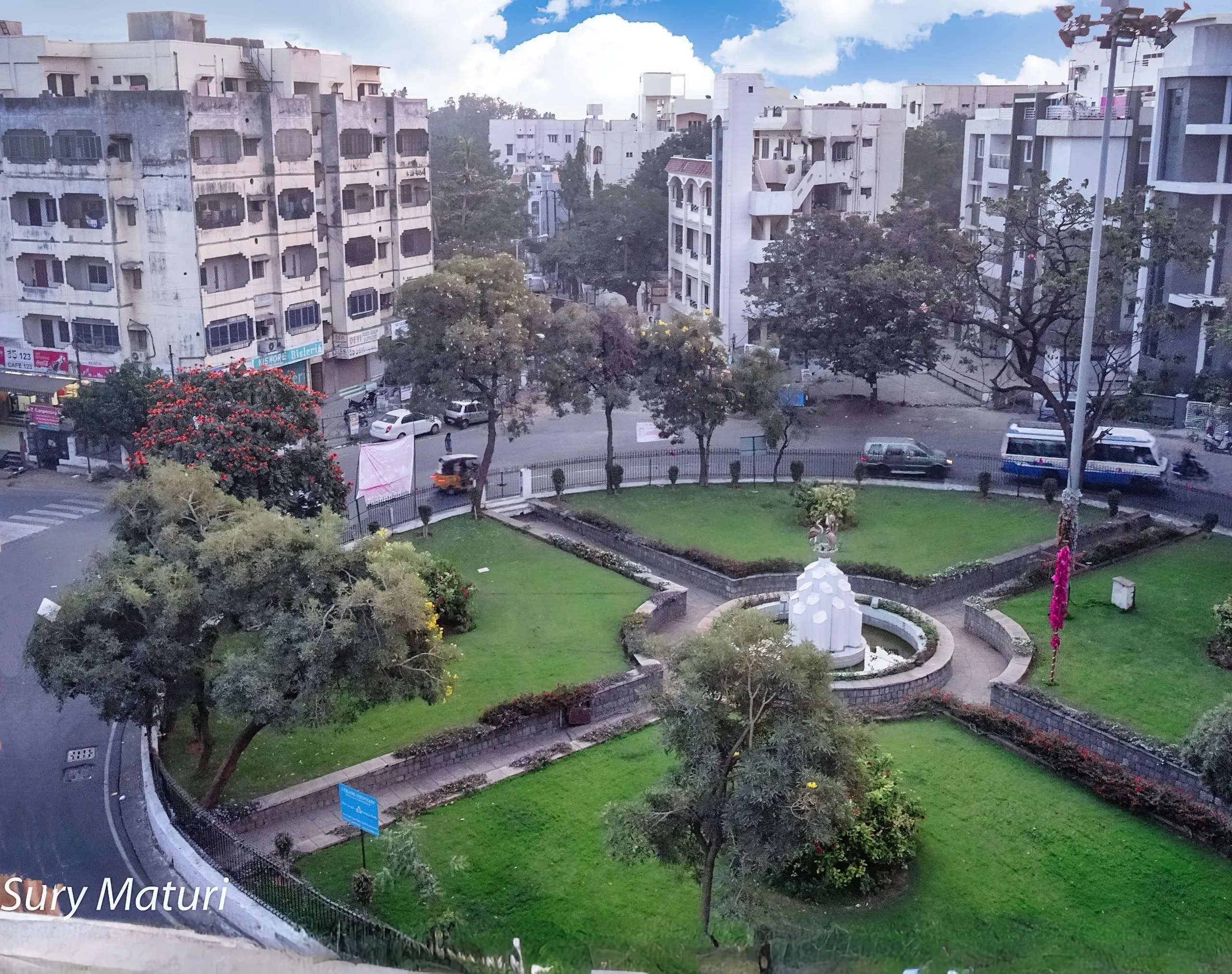
To transport you, dear reader, back to that time—summer of ’77 in Hyderabad—you’ll need to do some serious mental time travel. This was not the Hyderabad of today with glass towers, IT parks, and Amazon delivery scooters whizzing by. No, sir. Back then, Hyderabad was like the forgotten appendix of the Indian state. Think post-independence, pre-ambition. It was as if someone had pressed pause in 1951 and lost the remote.
Want a landline? Wait five years. Want a car? You’re dreaming. The city had about 5,000 cars serving two million people, and most of them belonged to government officers or movie stars. Information flowed in at a pace slower than our physics professor’s lectures—mostly via newspapers, old issues of Illustrated Weekly, and, inexplicably, a glossy Soviet propaganda magazine called Mother India, which we devoured mostly for the pictures and the unintentional comedy. Western magazines were as rare as an incorruptible politician.
TV didn’t exist. Radio gave us two channels, and only 45 blessed minutes per day were devoted to what was optimistically labeled “Western music,” a grab-bag of Cliff Richard, The Beatles (only the tame ones), and the occasional Elvis song. And don’t even ask about scooters. Getting your hands on a Bajaj was a multi-year saga involving connections, bribes, and likely a goat sacrifice under a full moon. It was the golden era of India’s socialist “Permit Raj,” also known as the art of getting nothing done very slowly.
There were about five or six of us who formed this ragtag fellowship—second-year engineering students, middle-class kids with big brains and very small wallets. The exception, of course, was Sury. He belonged to the Maturi family, which meant he had things like a late model car, real butter, and relatives who had actually been abroad. The rest of us made do with samosas, 1-by-4 chai, and big dreams. Our greatest luxury? The occasional shared cigarette and a seat in the grass under a mildly functioning streetlight.
That evening, I remember vividly. Sunil, Sanju, Saras, and I were already in the park, engaged in our usual three-pronged discussion: movies, unattainable women, and the soul-crushing boredom of existence. One Gold Flake was being passed around with surgical precision, when Sury arrived, breathless and bursting with energy—as if he had just returned from a summit with Einstein and Gandhi.
“I just came from the Nellores’ place,” he said, pausing dramatically. The Nellore family was Hyderabad royalty—educators, thinkers, a family so full of achievement they probably held breakfast debates on quantum theory.
“They had this magazine… The Scientific American,” Sury announced like he’d seen the Dead Sea scrolls.
He then proceeded to dazzle us with tales from this exotic publication. Strange new machines. Artificial intelligence (we assumed that meant a smart calculator). Space gizmos. His eyes sparkled. Ours widened.
And then came the coup de grâce—pronounced coop-dee-grass in true Hyderabad fashion. We waited, confused by the sudden outbreak of French, then leaned in.
“Tethered satellites,” he whispered, letting the words hang like holy mantras. “The Americans are launching satellites… with wires.”
We gawked. Wires? In space?
“Yes,” he said, “they send the satellite up, and it remains connected to Earth through a giant wire. They can control it, send it power, maybe even yank it back if needed!”
Images exploded in our heads—giant cosmic kites bobbing in the stratosphere, slowly drifting while whispering secrets back down to Earth through a galactic clothesline. Oh My God. The gizmos deliver untold goodness to the people of the Earth leading to the golden age that prophets and Gods have been promising us since times immemorial.
This, naturally, blew our collective minds.
After all, if there was one thing a pucca Hyderabadi knew, it was how to fly a kite. We weren’t just good—we were legendary. We could make kites dance, duel, and dive like fighter jets. And now, thanks to the Americans and their tethered satellites, our skill set could bring about the Golden Age and put Hyderabad on the World Map.
Excited, we began planning. Satellite tethering needed finesse, timing, and the ability to manage string with surgical dexterity. We had all that. What we didn’t have was a budget, any scientific knowledge of orbital mechanics, or a working prototype. But when has that ever stopped anyone from dreaming?
For the next hour, we sat in that darkening park under flickering streetlight glory, sketching plans with sticks in the dirt, discussing launch angles, gravity, and how to get in touch with NASA (“Maybe we send a telegram?”).
If you could bottle that energy, I swear, we could’ve lit up all of Hyderabad for a night—at least the part with working power lines.
Of course, none of this ever went anywhere. The Americans, it turns out, launched satellites without wires and did not need kite-flying brilliance of the Hyderabadis to perfect their space program. NASA never got to acknowledge our brilliance. Our tethering expertise remained strictly terrestrial.
But on that fall evening in 1977, for one perfect hour, we were not broke engineering students in the middle of nowhere. We were pioneers. We were dreamers. We were Hyderabad’s very own Space Cowboys.
And we were tethered—not to a satellite—but to each other, to our absurd hope, and to the sheer joy of being seventeen with nothing but imagination and a half-smoked Gold Flake to share.
V.S. Rao 7/18/25, Saratoga, CA.
Epilog: I don’t know if I know not, what I know not is Dunning-Kruger ( Dunning–Kruger effect – Wikipedia ) effect or is it a sign of intellectual humility, the fact remains that since 1977 I have remained the source of entertainment by being the butt of this joke. Sunder recently mentioned about tethered drones ( How Do Fiber Optic Drones Work? Everything You Need to Know ) and somewhat facetiously said that maybe I was prescient in 1977. We were on a hike and any component that is complimentary in his words, I attribute that to momentary oxygen deprivation.