Asked the protagonist in a recent movie I watched where he is a photographer. The protagonist is playing with the words but that lead me to ponder about the still life photography and its place in my world.
The question is deeper than mere word play, I realized as I started learning more about still life art in general, and still life photography, in particular.
I always thought that still life photography is relatively easy to master. After all, the subject is not moving, the ambient conditions are not changing except outdoors, and as a photographer I have full control.
From an Adobe article on how to take a successful still life phot, “Still life photography encompasses everything that is an inanimate subject in front of a camera. But a successful still life? That’s a little harder to classify. It all comes down to intent and context. Is your message conveyed? Is your composition strong, and does it guide the viewer’s eye through the image? Does your still life convey a narrative? It’s by asking these deeper questions that we can understand whether a photograph is successful.” The operative word here is “successful.”
I realized soon my mistake. I trivialized the task of still life photography by thinking it is a mundane task with not much involved. Like everything else in my life, I made assumptions and that came back to haunt me.
The aforementioned Adobe article talks about things to pay attention to, when taking a still life photograph. 1) Composition, 2) subject and materials, 3) lighting conditions, 4) camera angle, 5) focus and depth of field and 6) in an oxymoronic way, motion. So, if I drew parallels to my life, where composition, subject and materials are my current state of affairs, lighting conditions is my eco system, camera angles are my perspectives, focus and depth of field are my experiences, will then, can I infer still life photography is still life?
Here is an example of still life photography, an image I took where I had full control on all the five elements I alluded to, above. The lighting came from a flash (torch) light and cellphone.
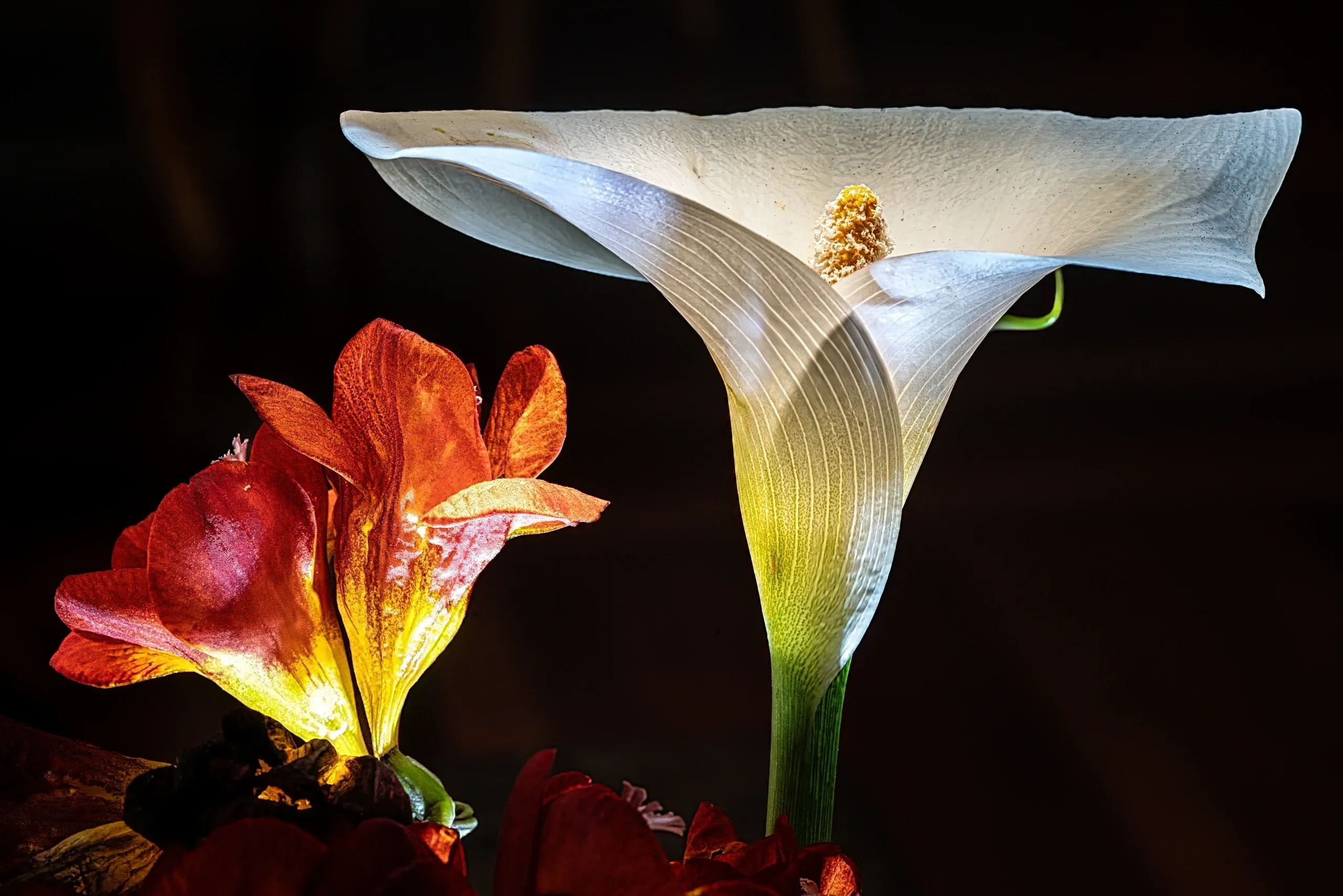
What I was going after in the above composition is striking a balance between details and placement. I wanted the red flower to provide a contract to the white of the calla lily and also have details of striations on the calla lily to be seen. Though the elements of still life photography were far from my mind at the time of taking this photo, I felt good that I was able to address the five elements without realizing it.
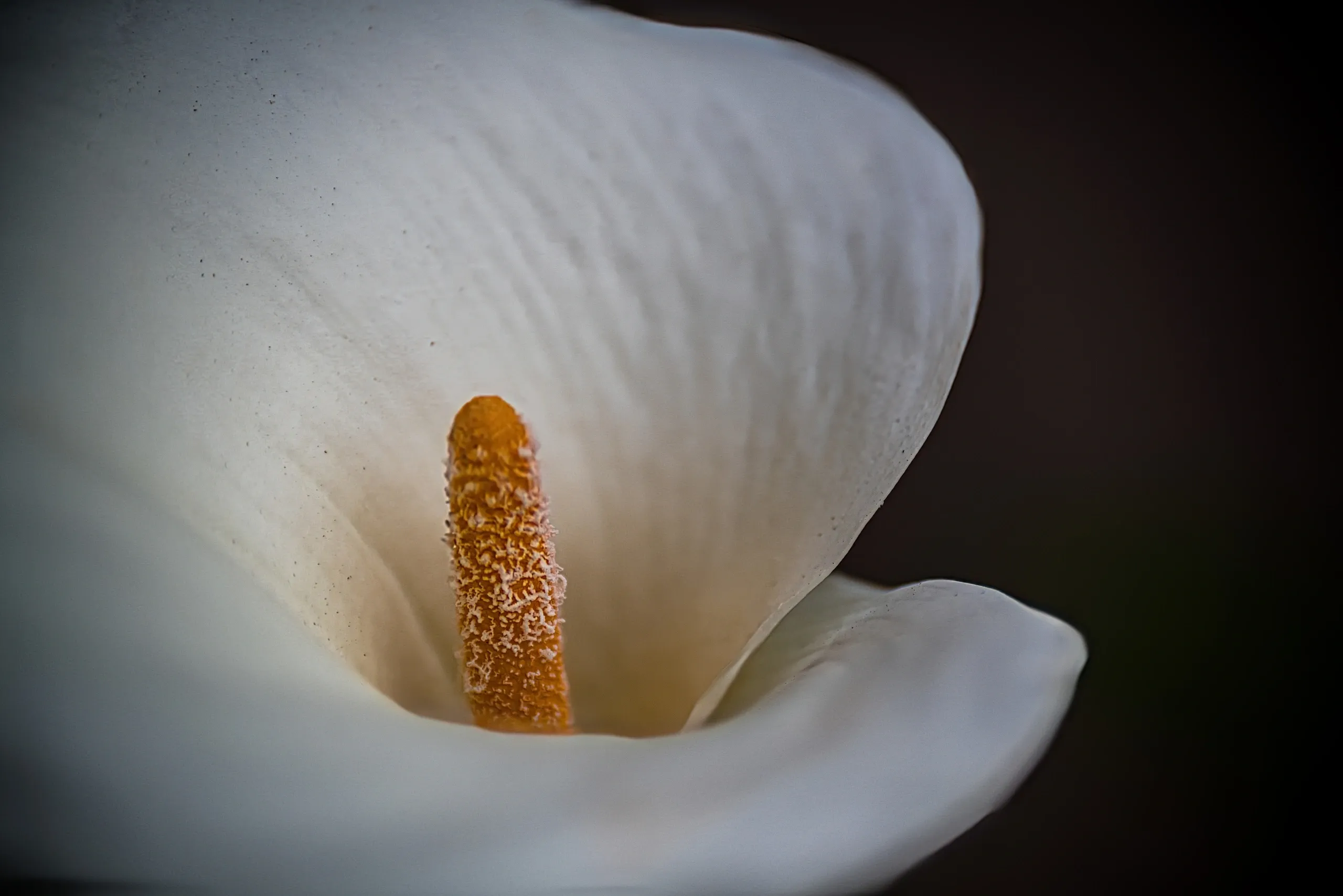
Here is another example of the same calla lily taken during daytime, with natural light streaming through the right of the viewer. A different angle, different focus, and a different composition of the same subject.
One of the rollercoaster rides I went through post-retirement was the sense of self-identity as it is a typical angst of one whose identity for the most part was defined by my career. As I transitioned from a structured life to free form living, I had my share of apprehensions, and disappointments about future and the past, respectively. As much as I focused on positivity in the ensuing five years since retirement, thinking about this article and the above images gave me a new clarity and a renewed sense of confidence that all is as well as it could be, and just take one day at a time, as the cliche goes.