for auld lang syne,
we’ll take a cup of kindness yet,
for auld lang syne.
and never brought to mind?
Should old acquaintance be forgot,
and auld lang syne?”
from morning sun till dine;
But seas between us broad have roared
since auld lang syne.”
- In West Bengal and Bangladesh the melody was the direct inspiration for the Bengali folk song “Purano shei diner kotha” (“Memories of the Good Old Days”), composed by the Nobel laureate Rabindranath Tagore, and forms one of the more recognizable tunes in Rabindra Sangeet (“Rabindra’s Songs”), a body of work of 2,230 songs and lyrical poems that form the backbone of Bengali music.
I was very piqued with curiosity to know if only the song is translated and is composed to a different tune. I found a rendition by Kishore Kumar on You Tube (Purano Sei Diner Kotha | Rabindra Sangeet | Kishore Kumar | Tagore Song By Kishore Kumar) and another version by Hemantha Mukharjee (Purano Sei Diner Katha | Audio | Hemanta Mukherjee | Rabindranath Tagore) closer to the original melody. I never would have guessed in million years that the great Tagore would find Auld Lang Syne so appealing and that it inspired him to pen a song that captures the spirit of Auld Lang Syne. But I digress.
I wish you all a very happy and healthy new year as I usher into my 6th year of this blog. This blog is my humble attempt at keeping my past alive lest it might be forgot. I am hoping you will too be inspired to renew your relations from the past lest they be forgotten. Here is to you all who have joined me on this journey and supported me unconditionally – from my family to you and your loved ones.
And there’s a hand my trusty friend!
And give me a hand o’ thine!
And we’ll take a right good-will draught,
for auld lang syne.
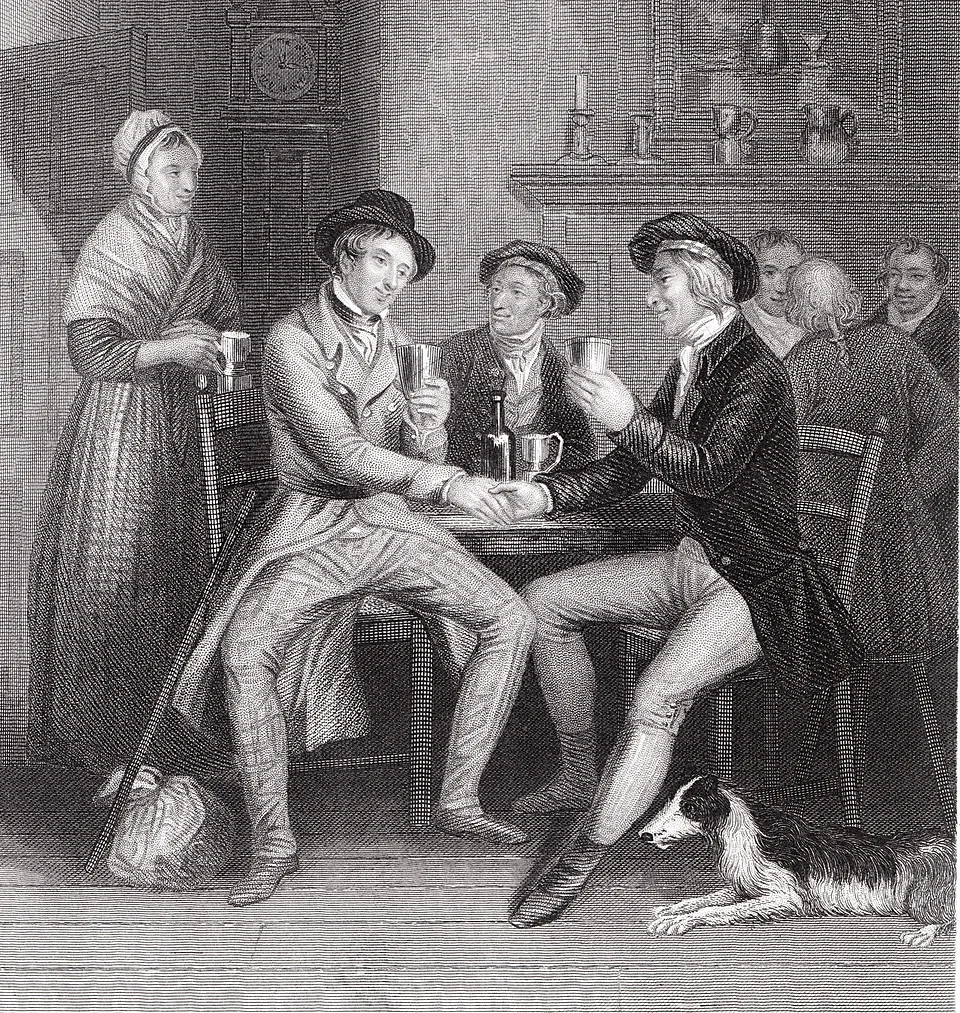
P.S. The featured image was a John Masey Wright and John Rogers’ illustration of the poem, c. 1841. Source – John Masey Wright – John Rogers – Robert Burns – Auld Lang Syne crop – Auld Lang Syne – Wikipedia – a public domain image.



Love this topic! I didn’t know about Tagore’s connection to the song, that’s very cool. You might be interested in John Green’s (brother of Hank Green, who you reference in a previous article) take on the song from his book/podcast, The Anthropocene Reviewed, which is a collection of essays on the human spirit. This is his take on the song: https://www.wnycstudios.org/podcasts/anthropocene-reviewed/episodes/anthropocene-reviewed-auld-lang-syne
Thank you, Kinnera for the feedback and the link. I thought I would be the first one to “interpret” this favorite song of mine. So, it turns out, I am neither the first one nor the last one. At least it is a validation of the theme. His article makes for a fascinating read. I will follow his work in the future.
Very interesting article and did not know these connections to the famous song ALS
Lovely articulation of the thoughts many seem to have as they get older. One gets to appreciate and understand the deeper meaning such songs convey to those who think about details.
Thank you UVN. I was a big fan of tune, the harmonies always left me with moist eyes, if not tears when I was feeling blues. I decided to find the meaning of the song on a whim, and it had a profound effect on me.